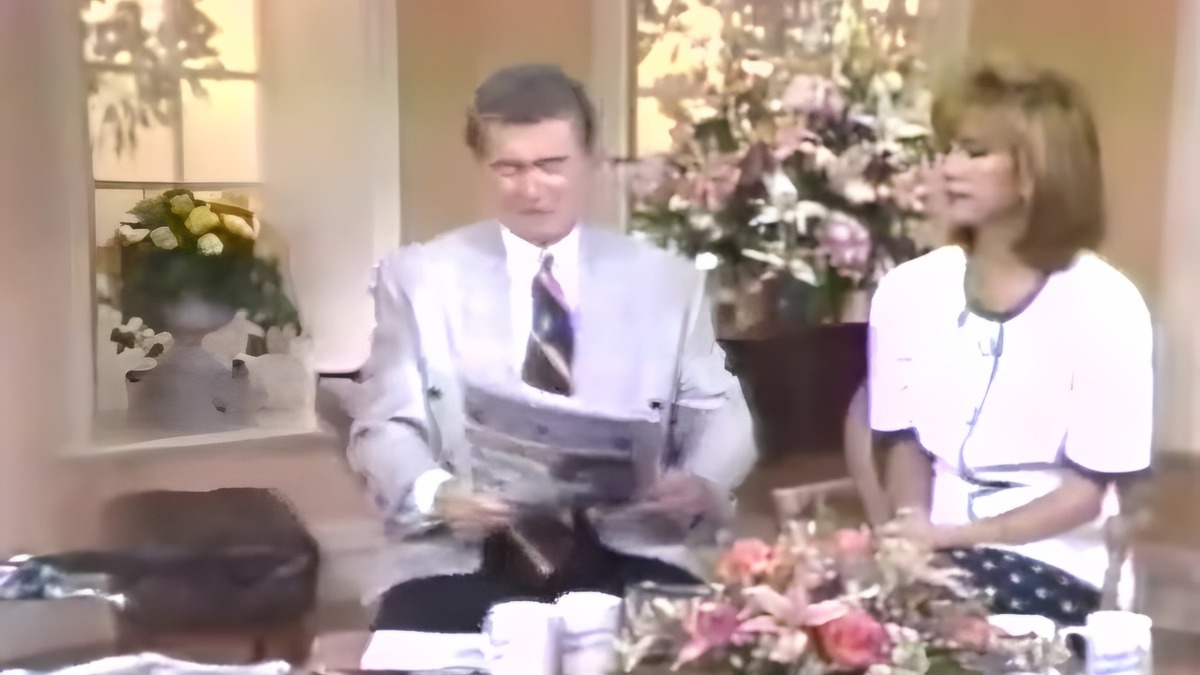
It is 1992. The bus is coming, the coffee is hot, and the small television on the kitchen counter has two people on it who are already mid-story about something that happened to one of them yesterday. Nobody in the house is sitting down. Everybody is listening.
Regis Philbin was born on this day in 1931, in New York City, and he spent more hours in front of a live television camera than anyone else who has ever done the job. The Guinness record is real and it is enormous, more than sixteen thousand hours on air. What a number like that cannot show you is the thing a morning like that one makes obvious in about ninety seconds. He could hold a room with nothing at all.
The format had a name. Host chat was the opening stretch of Live with Regis and Kathie Lee, where the two of them sat down with no script, no guest and no topic and talked until the first commercial. Most of television is engineered to make sure that situation never arises. Philbin built a career inside it.
He starts with something small, and usually something that went wrong. A restaurant, a cab, a neighbor, a thing his wife said. He tells it at full volume, gets halfway through, interrupts himself to argue with Kathie Lee about a detail that has nothing to do with the story, and lands the ending anyway. The audience is laughing before the punchline arrives because the shape of the thing is already funny. That is a skill and it took decades to build.
He came up the hard way and by a long road. Philbin served in the Navy, took a job as a page at NBC, then moved to Los Angeles and worked as a stagehand and a writer before anybody put him in front of a lens. He hosted a local late-night show in San Diego in the early sixties. He spent two years as Joey Bishop's sidekick on national television and learned exactly what it costs to be the second man in a room. Back to local television in Los Angeles, then Saint Louis, then Los Angeles again, and in 1983 he took over a morning show at WABC in New York.
That show went national in 1988 and changed daytime television. Every morning program that now opens with two hosts talking about their own week is working from the template he made. He did it without a monologue writer. He walked in, sat down, and started.
Morning television is a different contract from evening television and he understood the difference better than anybody. Nobody sits and watches a morning show. A morning show is on while you are doing six other things, in a kitchen, with a radio arguing with it from the next room and somebody looking for a shoe. It has to be worth half your attention and it has to survive you leaving the room for ninety seconds. He wrote for that exactly. Nothing he ever said was so important that missing it cost you anything.
The other half of it arrived in 1999, when ABC handed him a quiz show nobody expected to work. Who Wants to Be a Millionaire ran four nights a week that first summer and became the biggest thing on American television. He worked it the way he worked everything else, leaning in, dragging out the pause, asking the question everyone at home was already shouting at the set. Is that your final answer turned into a sentence you could hear in a hardware store.
He kept going. He hosted the Miss America pageant, he sang on his own albums, and he turned up on Letterman more than a hundred times purely because the two of them together were reliably funny. He took a season of America's Got Talent. He anchored his own morning show for twenty-three years and stepped away from it in 2011 with the record already out of reach.
What holds all of it together is that he never performed at us. He talked to us. The complaints were real complaints, the enthusiasm was real enthusiasm, and when something delighted him he would tell you about it for six straight minutes whether or not it looked interesting written down. He made an ordinary morning feel like company, which is a harder trick than it sounds and almost nobody else has managed it.
Two people, two chairs, no script, one camera. It should be nothing at all. It is the whole job.
Happy birthday to Regis Philbin, born August 25, 1931.